Cochetopa Pass
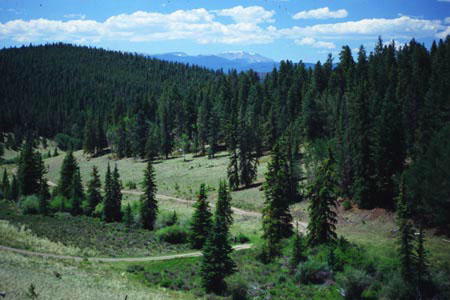
The maze of gentle rolling hills, rimmed by volcanic
caprock is not the kind of scenery that attracts
vacationers looking for the glory of 14 thousand foot
peaks, or the crowd looking for resort villages, golf
courses and scores of businesses to relieve them of their
money. But it is the kind of scenery that grows on some
people, once they are exposed to it. The maze of bikable
tracks through low hills leading up to dense forests, with
the occasional subalpine grassy valley thrown in, seems
endless, especially on the east side of Cochetopa Pass,
and this road itself is the most straight forward route
through the area.

click on profile for more detail
|
1.(8460ft,mile00) START-END EAST:
junction with Co119, joining the eastern side
over North Cochetopa Pass
2.(10032ft,mile11) TOP: Cochetopa Pass
3.(9250ft,mile17) forest road to Saguache Park
leaves on left
4.(9120ft,mile20) forest road to La Garita
Wilderness leaves on left
5.(9010ft,mile23) forest road to Pinos Pass joins on
left
6.(8810ft,mile27) START-END WEST: junction with
Co119, joining the western side of North Cochetopa
Pass
|
Approaches
From East. For the profile below both endpoints, see
the North Cochetopa Pass
profile. Cochetopa Pass leaves Co119 to continue its course
out on the windy plain. Instead it seeks shelter in the low
Rabbit Canyon, accompanied by comunication wires, that look
like a telegraph line from Otto Mears days. A gentle forested
climb gives way to a few rolling hills, sporadically offering
hints of views of the La Garita Mountains between a maze of
roads, begging to be mountain biked. In contrast to the many
tracks crossing the road, the route to the top of the pass is
easy to follow and consists of good hard dirt all the way
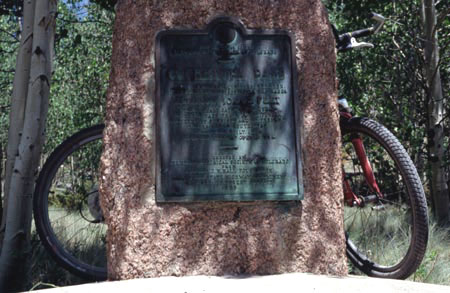
(July/05). The top is a peaceful forested spot with a simple
stone monument, pointing out the historical significance of
this inconspicuous spot. It also contains unlimited
opportunities for selfcontained camping in every direction.
From West. The initial approach pictured on the
profie is the only aspect of this ride that could be described
as unpleasant. This is the section following Cochetopa Creek
to upper and lower Dome Reservoirs. Apparently due to the
heavy volume of traffic to the La Garita Wilderness area, the
road is a little sandy and exhibits washboard characteristics.
But conditions improve with every mile of distance from its
beginning on Co114, until it's a perfectly smooth dirt road
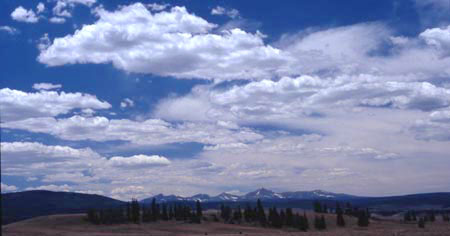
after 8 miles. At this point the La Garita Mountains make an
imposing panorama in the distance, albeit across a wide
expanse of private land. Now the road enters a low valley and
climbs to the top. A single switchback, utilized to gain
elevation, is the only hint of alpine character on the road
itself.
Tours
Dayrides. A ride from a campsite a few miles west of
Saguache, leading over Cochetopa Pass to its junction with
Co125, returning over paved North
Cochetopa Pass, measured 84 miles with 3250 feet of
climbing in 6.3 hours.

History
Travel over the Cochetopa Hills may be as old as the hills
themselves. Just exactly which tracks were followed in order
to cross what hills, that just happened to be located on the
continental divide, is subject to conjecture. But of the two
prominent crossings in the area, Cochetopa is thought of as
the old historic crossing. North
Cochetopa Pass is the modern highway. Ute Indians used the
area to hunt buffalo. Cochetopa is their word for "gate
of the buffalo". This also explains the presence of a
"Buffalo Pass Campground" on North Cochetopa Pass,
even though there is no Buffalo Pass anywhere to be found in
the area.
The intrepid Spanish trailblazer, De Anza, came charging
through the valleys east of here, over Poncha
Pass. He knew of the existence of Cochetopa Pass through
his Indian guides. But he did not cross it. Still, the Spanish
name for the pass, "Puerto de los cibolos", not gate
of the onions - that would be cibolas - but gate of the
buffalo, persisted into the times of anglo American
exploration. Later, when Gunnison crossed the pass, he called
it "Coo-chu-to-pe".
One of the earliest regular, anglo American users of the
pass was a Saint Louis Frenchman with business in Taos.
Antoine Robidoux first crossed the pass in a south to north
direction in 1824, while on a trading trip from Taos to the
lower Green River area. Later he used his connections in the
east instead, to bring supplies to the Green River area and a
subsequent fort in the Delta (Co) area by traveling up
the Arkansas River, then following Mosca
Pass, and Cochetopa Creek to Cochetopa Pass - same
destination, same pass, but now traversed while traveling east
to west. Cochetopa Pass was already an intersection.
The Gunison Rail Survey: (<Marshall
Pass|Blue Mesa Summit>)
Before you can have a transcontinental railroad, you have to
know where to put it - you need a railroad survey. It was the
right time in history for such a venture. The boundaries of
the US had been defined. In 1846 Britain accepted the 49th
parallel as southern boundary of British North America. Two
years later Senator Benton's expansionist movement had
resulted in Texas and New Mexico belonging to the US.
Americans scurried from one end of the country to the other,
easterners looking for gold in California, traders shipping
supplies to Salt Lake City and points in between. A debate
about where the first transcontinental railroad should be
built was a hot topic. In 1853, a full 15 years before the
first such railroad would finally be finished, congress
ordered a total of four railway surveys by the topographical
engineers, two of which included surveys of Rocky Mountain
passes. It is interesting to note right in the beginning, that
neither one of the two routes surveyed through the Rockies was
eventually chosen for the first transcontinental railroad. The
Northern Pacific expediton explored a northerly path through
Montana. A railroad approximating the route was eventually
built. But it was not the first transcontinental road.
Gunnison's railsurvey expedition followed a southerly path
over Colorado's Sangre de Cristo Pass and onwards to Cochetopa
Pass. In the end, the route finally chosen for the railroad,
crossed the Rockies between the two surveyed routes. It
followed a route much closer to the main traffic corridor
since since early trapper and settler days, the Oregon trail.
The reason for this background at this particular point in
the thread is that Cochetopa Pass turned out to be the
expedition's most interesting exploration. The stated
objective of the mission was to find a route across Sangre de
Cristo Pass (North La Veta
Pass) and Cochetopa Pass. When a hired mountain man from
Taos, named Antoine Leroux, guided Gunnison and his large
train of wagons and rifle men to Cochetopa Pass, they had
already examined a handful of passes. Besides noticing the
potential of Marshall Pass not
much new had been learned, until Cochetopa Pass. Leroux guided
Gunnison along a route to the south of today's road, following
Luder's creek to arrive at the pass. Captain Gunnison was in
high spirits. His assessment of Cochetopa Pass couldn't have
been better: "The ascent from San Luis Valley was very
gradual ... for a wagon road this pass is already
practical." The steeper western side was okay too,
requiring only four hours of work. That was enough time to
make a path for the wagons to slide down to Cochetopa Creek.
As luck would have it, the Gunnison's assesment was premature.
Cochetopa Canyon was only a hint of things to come.
Approaching Gunnison Canyon, the problems imposed by canyons
dwarfed those posed by mountains.

Cochetopa Pass never saw a railroad built over its top, even
though it would have been a practical crossing. Instead US
Army captain Marcy marked a route and built a rudimentary road
for wagons in 1853, en route from Wyoming to New Mexico,
travelling north to south like Robidoux first did, instead
east to west.
The Leadville Boom: (<Yellowjacket
Pass|Cerro
Summit/Blue Mesa Summit>) Cochetopa Pass played a role
in allowing the Leadville mining boom to spread south
westwards into the San Juans. Miners poured across the pass to
search for gold on Ute lands. Inevitably this resulted in
conflict between the Utes and the Anglo American newbies. When
the Utes were finally restricted to a reservation south of the
San Juan Mountains, Cochetopa Pass acquired a new usefulness.
Otto Mears Passes: (<Marshall
Pass|Los Pinos Pass>)
Cochetopa Pass finally became an economically interesting
route, when the time came to supply goods to the newly
established Ute reservation. John Lawrence built a road in
1869. But it soon became part of the Otto Mears toll road
empire. Based in Saguache, this was an early acquisition to
the intrepid imigrant's ever expanding toll road empire. When
the agency was moved west to the Uncompagre, Mears extended
his toll roads west over Los Pinos
Pass, onwards over Blue
Mesa Summit and Cerro
Summit.
So there you have it : from the "Gate of the
Buffalo" to the "gate to the reservations of the
people, who - once upon a time - hunted the buffalo ( over the
Gate of the Buffalo )".
|