>>
-

<<
-
TOP NAV reset map list all ??


advertisement

Colorado National Monument summit(u) 

Even the Park Service's official map and guide pamphlet states that Rimrock Drive is ideal for bicycling. I don't know of any other Park Service Publication that even mentions bicycling. So it must be good ! And it's true, the largest portion of road cyclists out and about between Fruita and Grand Junction are likely to be found on these 30 miles, weather permitting. The word Rimrock Drive just about says it all, except that it should be called Rimrock Ride. Traversing the route from Grand Junction to Fruita lets you ride on the side of the rim and saves the Monument Canyon overlooks for last, while riding from Fruita to Grand Junction often provides better light conditions and hence better views once arriving at the switchbacks on the eastern side. The ride is short enough to do both.


click on profile for more detail
1.(4500ft,mile00) START-END WEST:  downtown Fruita
2.(4680ft,mile03) go right into Colorado National Monument
3.(5790ft,mile07) Park visitor center and Saddlehorn campground are on left.
4.(6470ft,mile14) western turnoff to Glade Park is on right.
5.(6673ft,mile18) TOP: high point
6.(6211ft,mile22) eastern turnoff to Glade Park is on right
7.(4951ft,mile26) eastern park entrance
8.(4550ft,mile29) START-END EAST: bridge across Colorado River. junction of Co140 and road into Colorado NM.

Approaches

From North. Co340 leaves Fruita by crossing I70 and skirting a few businesses designed to alleviate tourists of too much time on their hands, such as a Dinosaur Museum, aimed mostly at children. Rimrock Drive deviates to the right past a small entrance booth. After gaining a few feet of warm up elevation, the road starts to traverse up the south side of Fruita Canyon, only to reverse its course at its head, and continue to climb back on the other side of the canyon, utilizing two short tunnels. Now on the slanting plateau slope, five loosely spaced switchbacks make their way up to the edge of the plateau.

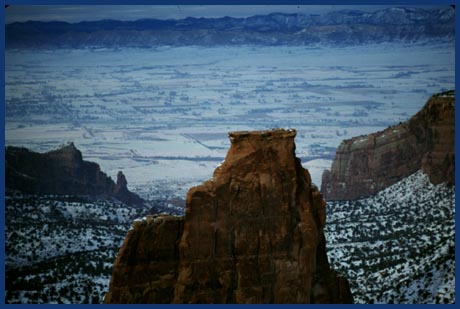
A campground, picnic ground and visitor center mark the beginning to the section, that sheds a whole series of views onto the most striking rock formation along the road, the Kayenta formation capped monument, named Independence Rock for patriotic reasons. The road diverges from the rim only for very short distances. When Independence Rock is is finally seen the last time, it is from the opposing direction as when first catching a glimpse of it.

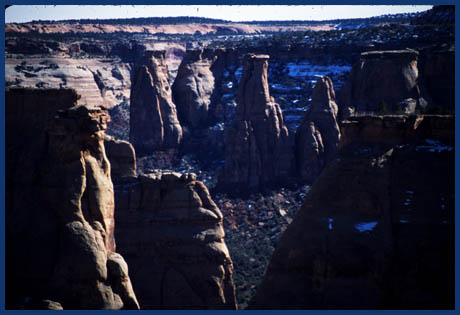
The next set of rock formations to the south lack the hard Kayenta cap rock and hence have eroded into a series of large beehive shapes, or coke ovens as they are officially named. After more rock formations the road diverts into the plateau, away from the rim, where it reaches its highest point surrounded by juniper forest.

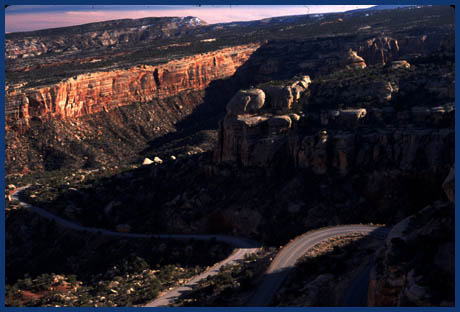
From South. The beginning here too is marked by crossing the Colorado River, this time just outside Grand Junction. Monument Road heads past new developments. Once inside the monument 10 switchbacks and one short tunnel help propel the rider to the top. The spot on top of the last curve, with the switchbacks tightly wound below, and the slanting rock layers falling off into No Thoroughfare Canyon is the most impressive spot for me on this side. The canyons between here and the summit, Columbus Canyon and Red Canyon, are exceptionally straight and appear like nature's bowling alleys. The road diverts into the plateau to climb the final feet to the summit. The summit is not marked as such on the Park Service's official guide map, or the road itself. But the map contains an elevation label.


Tours

Dayrides. A loop ride over this road between Grand Junction and Fruita is the best paved day ride in the area. It can be short enough to fit in half a day, or it can be extended to any distance with innumerable options to close the loop in Grand Valley. The ride is feasible during much of the winter.

One Week (Very) Large Group Ride: (<Black Mesa summit(u)): The large groups of "Ride the Rockies" traversed this summit once between 86 and 2005. This happened on the first day of the 2005 tour, effectively a day ride that began and ended in Grand Junction. After that the riders headed to Rifle and then over the Co13 summit(u): Rifle - Meeker. 


History

The establishment of Colorado National Monument was spawned by the determination of a single man, impressed with the beauty of its landscape. John Otto arrived in 1907 and promoted the place by building trails. The monument was established in 1911 and Otto became its caretaker for a dollar a month till 1927.

Once upon a time Colorado had a road bike race named after a large, socalled beer brewing company, the Coors Classic. A stage over this road was known by the peculiar name "tour of the moon".

back to Colorado Pass Tables Page


-------
Copyright (C) by Michael Fiebach 2003-2011
-------