>>
-

<<
-
TOP NAV reset map list all ??


advertisement

Mosca Pass

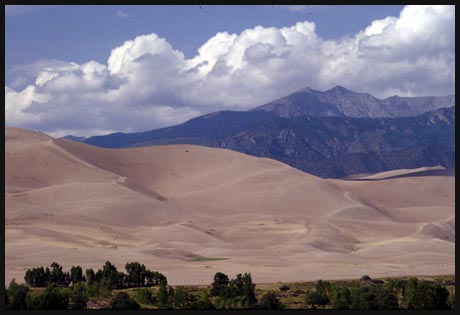
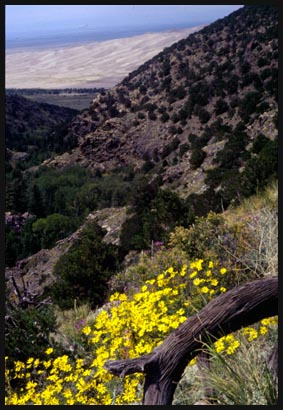
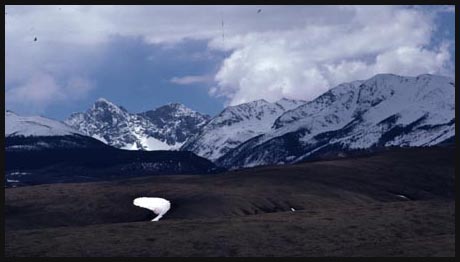
Only the eastern side of Mosca Pass is currently open to bicycles. Route suggestions over the pass are presented only for completeness sake, in case the route opens again. Mosca Pass is the next low crossing of the Sangre de Cristo Range, north of the historically well traveled La Veta Pass area. Mosca Pass shares in the rich early history of La Veta Pass and is about 350 feet higher. Between the two crossings towers the 14000 foot Blanca massif, southernmost bastion of high alpine Rocky Mountains. Many of the best views along the pass seem to be slightly off route. The first picture was taken direction headwaters of the Huerfano River, mentioned in the "approach from east" section. The other two pictures also, were taken while exploring a little further beyond the trail on foot, first near the top (2nd picture), and lastly approaching the Sand Dunes area.


click on profile for more detail
1. (mile00,6960ft) START/END-EAST: Gardner
2. (mile01,6995ft) turn left up Mosca Pass dirt road, stay straight immediately after
3. (mile05,7531ft)Malachite town site
4. (mile13,8435ft)stay right at junction following May Creek
5. (mile15,8845ft)stay left at junction
6. (mile18,9167ft)stay right at junction
7. (mile19,9740ft)TOP: Mosca Pass
8. (mile22,8263ft)turn right onto paved road to Sand Dunes National Monument
9. (mile23,8298ft) START/END-WEST: Sand Dunes National Monument

Approaches

From East. From Gardner the pleasant, flat 550rd serves as access to Mosca Pass and Pass Creek Pass. When reaching an area labeled Sharpsdale on maps, views of the Blanca Massif tempt towards the left fork, direction Huerfano SWA. The Mosca Pass road however finally leaves the Huerfano River, which has historically lead visitors towards the pass. The road stays to the right, in sage country, traversing none of the alpine scenes that are visible from afar. After a single traverse to the top, just as you catch a historic glimpse of sand dunes far below as some of Pike's men may have seen, the double track turns to a single track trail. But bicycles are prohibited beyond this point. The first picture is taken from near the top while exploring the area a little further on foot.

From West. As mentioned above, the trail on the western approach, between Sand Dunes National Monument and the top of Mosca Pass is currently closed to bicycles. If it were not, it would be a perfectly bikable route, escpecially in the downward direction. Obviousely the fastest way to traverse the approach is in a downward direction. It is only about three miles long. Steepest section is near the bottom.


Tours

Dayrides. If the western approach to Mosca Pass would be open to bicycles, a circle day ride over Mosca and Medano Pass would be feasible. For other difficulties with this route see Medano Pass. Once upon a time this ride measured 52 miles with a mechanical onboard odometer (m1:87.05.09).

History

In spite of being partially a narrow trail today, Mosca Pass is a historic thoroughfare. The story of  stumbleing across the amazing sand dunes for the first time is bound to be interesting. But even after that Mosca Pass had a practical reason for its existence. Even though travelers had many passes to choose from, Mosca was a happy medium between longer, easier and shorter, higher options.

Pike (<Medano Pass): Mosca Pass forms the last episode in the misadventures of Zebulon Pike in 1807, who still harboured hopes of finding the Red River in Colorado. Previousely the had crossed the adjacent,  Medano Pass, where Pike's Red River disappeared into the sand. He finally decided to retrace his way back to the Canyon City campsite. In order to avoid the sand of Medano Pass part of the group used Mosca Pass instead. But Mosca didn't tread Pike's men kindly either. Here they had to deal with snow instead of sand.

These two passes, Mosca and Medano would later show up in Pike's reports with the adjective "very bad" preceeding them. Pike missed the one "very good" pass, as far as ease of crossing is concerned, although it was well known to the Spanish since the times de Anza crossed it on his Comanche chase around the Sangre de Cristos.

In Pike's further adventures he becomes a prisoner of the Spanish, and is hauled off to Santa Fe and then Chihuahua, Mexico. His maps and letters are confiscated. Pike's jouriney was not the last futile search for the Red River, which starts in Texas - not in Colorado.

Pike's exploratory accomplishments were largely ignored. Today he is memorialized by the peak he didn't climb. Still, he brought back information about a good two dozen passes, and it would take decades till other explorers returned. It is not surprising that posterity did not bestow upon Pike and his 16 man expedition the same glory as upon Lewis and Clark. You can't find any "Pike Autotour" booklets, complete with numbered turnouts. Soon after Pike returned from Mexico, he was believed to be involved with Senator Wilkinson's hairbrained scheme to establish his own country west of the Alleghenies.


By the 1820 an early trader knew the Mosca Pass area much better than Pike. For him the pass was a shortcut. Antoine Robidoux preferred Mosca Pass to Sangre de Cristo Pass. The route avoided the detour around the Blanca Massif on the way up Saguache Creek to Cochetopa Pass. He traveled the route regularly to supply his trading post, located near today's Delta on the Gunnison River. There is still a museum near the site. Where did all this geographical knowledge come from ? Robidoux started out running trade trips from Taos north as far as the Green Riverarea in Utah, crossing Cochetopa Pass in the process. However, he also had family connections east. Consequently he later ran his supplies up the Arkansas River. Here he was presented with the same geography as Pike was two decades earlier. Travelling up the Huerfano Valley towards Badito Cone, Mosca Pass was a medium between Medano Pass and Sangre de Cristo Pass, a pass with good grazing between a pass that was shorter but too sandy, and another pass, that was lower but too long. The name "Robidoux Pass" was used hence by American travelers who were Cochetopa bound. The pass was so popular that a small supply town, named Mosca, developed at its western base. The name "Mosca", spanish for fly and describing the summer conditions at the top, also returned to today's maps.

Gunnison Rail Survey (<North La Veta Pass|Medano Pass>) Mosca Pass was also inspected by Gunnsion for its suitability as part of the first transcontinental rail route. Mountain man Antoine Leroux from Taos was employed to guide the group of topographical engineers to the pass and onwards across southern Colorado. The verdict: "The route was found to be entirely impractical for a railroad ... because it was rocky and precipitous.


Hayden Survey
(<Hayden Pass|Jack's Cabin Pass>) : By the time the Hayden Survey took its inventory of Colorado passes in 1873, a new toll road existed over Mosca Pass. Again its reason for existence was as alternative to the old Sangre de Cristo Pass (today's  North La Veta Pass). Pass


By the 1880s the road was used by stages, connecting Silver Cliff with Mosca. But the road was heavily damaged in three subsequent floods, and in 1901 the toll road was abandoned. A state road map from the 1930s shows the pass as a dirt road, and as late as 1964 the state highway department considered building a road over the top. Instead a three mile stretch of the path is even closed to bicycles today.

Cycling. An early mountain biking guide, first published in 1987, mentions Mosca Pass as being suitable for mountain biking in its appendix, without describing it any further (William L. Stoehr's: Bicycling the Backcountry).


-------
Copyright (C) by Michael Fiebach 2003-2011
-------