North La Veta Pass
A pass in the Sangre de Cristo Range - range of 14000 foot
giants like Blanca, Ellingwood and Little Bear ! What
could this pass look like, switchbacks up a mountain
staircase ? Not even close ! North La Veta Pass is a
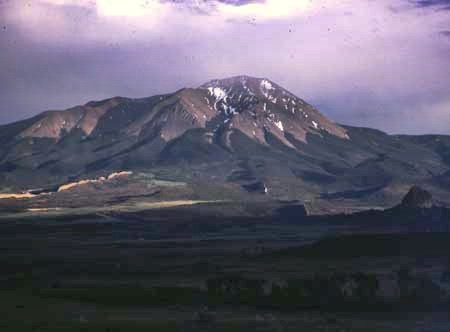
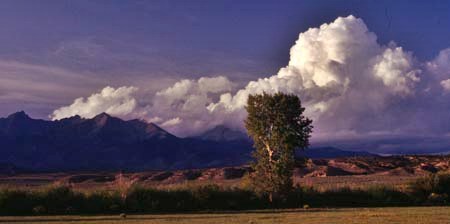
gentle highway. Its beauty lies in its sage hills and
straight alluvial fans that kneel at the feet of these
giants. North La Veta Pass is today's highway across the
gap. but it's far from being the only pass crossing in
this wide gap. If you look to the mountains on
either side of it, you can see why. Would you put a pass
up there ? Not if you can conduct your Comanche chase down
here. The other passes are Pass
Creek Pass, Old La Veta
Pass and Veta Pass. The history section, here and on
the Old La Veta Pass page, will help you keep them
straight.

click on profile for more detail
|
01. (mile00,7946ft) START-END WEST:
Fort Garland
02. (mile10,8273ft) dirt road turn off leading to
railline is on right, stay straight
03. (mile17,9071ft) dirt road turn off to western
approach Old La Veta
Pass is on right, stay straight
04. (mile18,9108ft) dirt road turn off to dirt road Pass
Creek Pass is on left, stay straight
05.(mile20,9413ft) TOP: NORTH LA VETA PASS
06. (mile22,8783ft) dirt road turn off to eastern
approach of Old La
Veta Pass is on right, stay straight
07.(mile30,7500ft) shorter alternate route for fat
tires to La Veta is on right
08.(mile32,7225ft) another possibility to cut off a
mile or two to La Veta is on right.
09.(mile36,6820ft) ALTERNATE START-END EAST : turn
off toLa Veta is on right, go right
10.(mile41,7030ft) START-END EAST : town of La Veta
|
Approaches
From West. Fort Garland is the closest town, even if
there are miles of gently rolling sage hills between the town
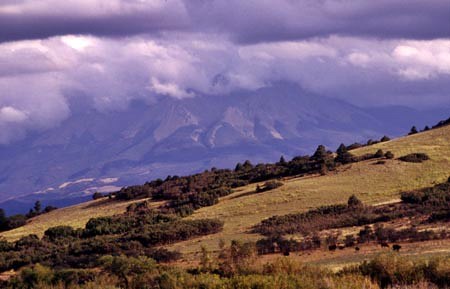
and the slope up the pass. This side affords impressive views
of the the Blanca massif. But in an area like this, the best
vantage points on the mountains are often in the valley
itself, where just a small increase in altitude can extend
your field of view by 10s of miles. The second picture shows
the Blanca Massif from a valley vantage point near Fort
Garland.
From East. If a motorist is asked where La Veta Pass
starts on the east, he will probably answer Walsenburg. Maybe
that's because the character of the top of the pass is so
unalpine, that the sage flats of Walsenburg don't seem much
different. Even the "Colorado Pass Book", a
publication aimed at 4 wheel drive enthusiasts, mentions
Walsenburg in conjunction with La Veta Pass. The town of La
Veta is several miles closer to the pass, and admittedly a few
feet higher. But it makes a better destination, nestled
between the Spanish peaks and the pass. If you have time to
spare there's an old Fort to visit.
Tours
Dayrides. For a road cyclist there is only one
option to ride over the pass in a day : Cross the pass and
return from whence he came. The cyclist not limiting himself
to impervious pavement has a wider choice of options. One
direction can be ridden over Old
La Veta Pass. It's a alternative to the sparse but fast
traffic racing over the modern highway.
One Week (Very) Large Group Ride: (<Lizard
Head Pass|Gore Pass>):
Between 1986 and sofar (2005) the pass was twice on the Denver
Post's "Ride the Rockies" itinerary. During 94 and
00 the stage was Walsenburg to Alamosa.
History
Just because North La Veta Pass lacks alpine character
doesn't mean it is not beautiful. I personally love the sage
expanses in front of these monumental dessert peaks. Weather
it conforms to ideas of scenic beauty or not, its historical
significance is unequivocal. The story how this huge gap in
the southern Rockies was first utilized, and how it formed a
boundary between the Spanish and American cultures make it
arguably the most interesting story in the early history of
the passes.
de Anza(<Ute
Pass|Pass Creek Pass>):
The pass enters the pages of history when it was crossed
by the governor of New Mexico, de Anza, on a wild Comanche
Chase. He used the name "Sangre de Cristo
Pass". Today the name could refer to any of the passes in
this gap, this one, Old La Veta
Pass or Pass Creek Pass.
The de Anza story starts on the Poncho
Pass Page. To see how he arrived here, check the Ute
Pass page.
After de Anza had crushed the control of the Comanches he
was on his way back home to New Mexico. It was on the
leisurely ride home, that he made the pass discovery that
would have the greatest impact on the future. It was not what
he could have foreseen. This was not a gap towards the remote
western remote Spanish empire in California, but faced the
opposite direction. The pass faced east from the north of New
Mexico. It was a gate to the plains and the upper Arkansas. De
Anza named the pass "Sangre de Cristo Pass" because
it was the obvious route through the mountains of the
same name. The pass most closely associated with this name is
"La Veta Pass", which today on the map is written as
"North La Veta Pass". De Anza's approach was really
between up "Pass Creek Pass",
and down "North La Veta Pass". That's why the
story about de Anza continues on the Pass
Creek Pass page.
The eastern approach to North La Veta Pass exists since the
1960s, when the highway department relocated the highway on a
more direct route. The western approach has essentially
remained unchanged since de Anza's Sangre de Cristo Pass.
Other historical periods pertaining to the area are described
on the Pass Creek Pass and Old
La Veta Pass pages.


| North La Veta Pass (Summary)
Elevation/Highest Point: 9413 ft
|
|
Western Approach: paved road
|
climb
|
distance
|
drop
|
from Fort Garland (7946ft)
|
1467 ft
|
21miles
|
~200ft
|
Eastern Approach: paved road
|
|
|
|
from La Veta (7030ft)
|
2383 ft
|
20+1/2miles
|
~200ft
|
from US160 turnoff to La Veta
(6820ft)
|
2593 ft
|
15+1/2miles
|
|
|
---------
View
Larger Map
---------
|
|